Showing posts with label marketing - internet. Show all posts

10.13.2010

Cheap internet marketing tricks - counting impressions

Counting clicks is one thing, and counting impressions is something else. Everyone who is anyone in internet marketing counts both. Google does it, and Amazon does it. All the merchants who use Commission Junction do it too.

An impression happens every time someone sees your link or ad, whether they click on it or not. The ratio of impressions to clicks tells you something about the efficacy of your ad or link. Counting impressions is fairly easy by counting the number of time an image is displayed on a page. Amazon and Commission Junction use tiny little 1 x 1 pixel images with text links, so that things don't get slowed down much, but any image will do the job.

If you have access to a server log, that is one crude way of counting the number of times an image file is accessed, or a simple PHP script will also work. But, what if you don't have access to a server, don't know a log from a hole in the ground, or never heard of PHP?

There's a simple trick you can use.

working image
Bit.ly is a free link shortening service, but it also works with image links. Bit.ly records stats on how often the shortened link is accessed. Usually, for a normal link, this would mean that the link was clicked upon, but an image link does not require a user to click it. The link is accessed every time the page is accessed and the image displays. Thus, it keeps a rough count of impressions.


Webinars: What's the point

I receive a lot of invitations to webinars, and many of them are free. I never accept the invitations anymore, even for the many that I find to offer an interesting topic. With webinars it is always for a specific time and a specific date that I have to 1. Remember, and 2. Not be doing something else.

What's the point of that?

The technology of webinars offers a fine opportunity for intense interaction that does not require travel or taking a shower, but just to listen to a presentation? I'm interested in webinars for the purpose of learning something new, and not to offer what I already know. As for the possibility of asking questions live, if that is even made available, it is fairly useless to me.

All my best question arise at least three hours after the presentation is over, and everyone has gone home.

Record your presentation and put it on YouTube so I can watch it at 3 AM, which is sometimes best for me. Don't ask me to be sitting in front of my computer for an hour at a time certain and with a date fixed by you. It goes against my basic principles.

Give me a pause button at least, so that I can get up and walk around when it all gets too boring for me.

8.21.2010

And the winner is . . . Koornk

It was three weeks ago today that I began my syndication experiment with this blog, or to spam the universe through an unconscionable misuse of RSS feeds, as some might say. The main purpose of the test was to see through experience how RSS feed syndication worked in practice, using only free online services. A second purpose was to find and reach new audiences that might be interested in my writing. Third in order of discussion was the possibility of self-created back-links to this blog to increase traffic and boost PageRank.

An important issue was the question of indexing the various blogs, quasi-blogs, and micro blogs by Google. The points of interest were: (1) If, (2) When, and (3) What effect?

Today I found out the answer in a small way. My Koornk blog  was the first of my testbeds to have a feed back-link indexed by Google, as shown in this screenshot. The Google search result for Koornk linked to the individual post, and not to the main blog page.  Due to the quirkiness of the system I cobbled together, the back-link is not to this microenterprise blog, it is to an intermediary transmission stage of mine located on Status.net.  Don't ask why.  It's complicated.

Screenshot of Tom Fox Koornk blog

Local web marketing through Google WebClips

I like to push buttons and click links just to see what happens, secure in the knowledge that if things go south I can always reach over and pull the plug, literally.

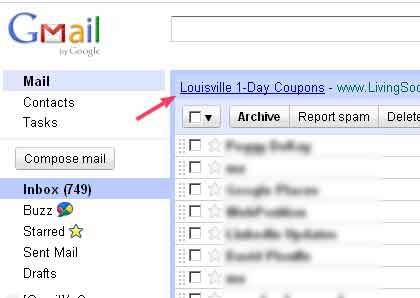
I enabled Google's WebClips in my Gmail web dashboard out of a need to satisfy my curiosity, and I was lucky to immediately discover the LivingSocial.com site I've written about as a result. WebClips is an amalgam of pre-loaded syndicated feeds, that I might or might not be able to edit and add to, mixed in with a dose of shameless commercialism and advertisements through Google. These are displayed one at a time discretely at the top of my mail inbox. The first one I saw after enabling the feature is shown below, and it was location specific to me, here in Louisville, Kentucky. "Louisville 1-Day Coupons."

I pushed the button out of curiosity and found LivingSocial.com's Louisville page and deal of the day. So far, LivingSocial Louisville looks great, and it bears looking into further.

Note: August 21, 2010 - afternoon

Really, Google Web Clips on Gmail does not have anything to do with local web marketing, per se.  Just so happened the LivingSocial's ad was the first one I saw.  I'm glad I saw it.  LivingSocial is something I need to know about.  All the rest of the advertisements since then have been fairly typical.

Screenshot of Google Gmail with WebClipsPublish Post

8.20.2010

Incomprehensible irrelevant uncertainty as a marketing tool

Screenshot of Groupon.com offer
My question for today is: Does gratuitously injecting an element of incomprehensible irrelevant uncertainty into a sales pitch increase sales?

I think not, but I'm not an advertising professional and I don't have access to the split-test comparison data.

At first glance, the deal offered by Louisville's Bard's Town Pub through Groupon.com is straightforward. Spend $10 today, get $20 in beer and burgers tomorrow, and the opportunity will be available for another 2 days, 16 hours, and 19 minutes, more or less.

First thing in the morning I can understand that much.  I can even read the fine print without being shocked, dismayed or confused. In my mind it is a really good deal to make your beer and burger money go twice as far.

Then I get to the "46 bought, 54 more needed to get the deal" part of the ad.

I don't appreciate my WTF? moments to start coming quite this early in the day.

Nowhere in the fine print does it say "Offer not valid until a minimum of 100 people buy-in."  It would be a logistical and logical nightmare, not to mention a big legal problem, to structure the deal that way.  You can buy it today but you have to wait 24 hours before using it (fine print) tomorrow, except if less than 100 people opt-in before the offer ends on Tuesday in which case it is not valid at all?  This does not work.

What sensible reason does Goupon have for doing this?  What are they thinking?

8.19.2010

Internet marketing for local business - LivingSocial.com and Groupon.com

LivingSocial.com is best known from its Facebook app business, but it also has a parallel web-based presence outside of Facebook. LivingSocial has pushed its web presence toward marketing local businesses. When I visit the LivingSocial.com URL, I get my location specific page, LivingSocial Presents Louisville - my home town.

The tempting offer is an opportunity to purchase a $30 gift certificate to a local Louisville business for only $12. It looks to be a very good deal. It was a business that I had never heard of before: Amazing Green Planet. I don't travel in that part of town often these days.

A list of U.S. cities served by LivingSocial can be found here.

Groupon.com offers a similar service. Today's deal that comes through Groupon is $25 to buy a $50 gift certificate from Gap.

Either of these two deals qualify as a loss-leader, being an offer to double your money. But the two deals, one from Amazing Green Planet and the other from Gap, are of different value to the advertisers. The potential benefits are:
  1. Awareness,
  2. Action, and
  3. Buzz
Amazing Green Planet bought a whole lot of awareness by advertising through LivingSocial.com. I had never heard of the store before, but now I have a favorable impression, I'm curious, and I know its general location. Like me, most people who see the advertisement will not act on the offer outright, but they may remember it.  I can't say the same about Gap's ad. I didn't learn anything new. It was  just another Gap ad.

I was tempted by the Amazing Green Planet offer because it seemed to be such a good deal, even though I wasn't sure what the store sold and there isn't much I want to buy. I fell back to my default position that the best way to save money is not to spend it.

In both instances I was tempted to take voluntary action to share these two deals with some friends.  With Amazing Green Planet it was because I though the store looked cool and I want to know if any of my friends had knowledge of it.  The Gap offer would go to friends who shopped at Gap anyway.

But I didn't.  I did not buzz a single chirp, nor a tweet.

Seealso: Deal or no deal? What’s the deal?

8.14.2010

Slow change and small business

"The slow changes in the media landscape are accelerating and virtually every pre-digital system is in danger. The slow changes in the marketing landscape are in their second decade and these changes will have their effects on every business and cause as well." - Seth Godin

In 1987 my wife and I started a retail computer store. We had a good location and we put a lot of money into advertising.  This consisted of Yellow Pages ads, newspaper ads, and local radio ads. It was effective to build the business.

I doubt that it would work today.  I don't remember the last time I looked through the Yellow Pages, read a newspaper, or listened to local radio ads.

Things have changed.

8.07.2010

I doubled my blog traffic in one week with social media

Except that going from 25 visitors per day to 50 visitors per day is no big deal, and spending 25 hours to do it is silly.  Then there is the fact that it will fall off once I stop humping it.

Don't be a chump.  Hype is hype.

8.02.2010

Blog post syndication distribution channels and map

The native Really Simple Syndication (RSS) feed for this Blogger blog, microenterprise, is re-directed to Google Feedburner, and anyone can subscribe to the feed in a number of different ways including the free email distribution that Feedburner provides.  More than that, by using the many social media, automated ping services, and micro-blog platforms freely available today, I have recently constructed an entire distribution channel that pushes my posts down a networked distribution channel.

This is just a beginning that I cooked up yesterday afternoon, and there is a lot of room for expansion.  More importantly, there is the question about the effects, if any, that the distribution network has on traffic and rankings.

I created a visual representation of the RSS distribution channel here, on Scribed.com.

August 3, 2010 Update

1. I removed my test blog on Presently.com from my distribution channel. Presently.com is in the business of creating and selling enterprise in-house micro-blogging software.  The free hosted micro-blog that Presently.com offers is intended, it seems to me, as a live demo of the software, rather than as a working tool or community in the public internet environment.  I looks like fine software, but it wasn't designed or intended for my purpose.

2. Since I will be originating posts on Tumblr.com, to keep it alive, I decided those new posts will be distributed to Twitter and Facebook.  Why not?

3. Moved Facebook off of my Twitter feed and onto a Ping.fm feed for the Microenterprise blog posts.  The way it was before resulted in double posting of Tumblr posts on Facebook.  Not good.

The RSS distribution channel map has been revised, expanded, moved, and re-published, here.


Tom Fox
Louisville, Kentucky
Tom Fox on Twitter

7.28.2010

Establishing an internet identity - your original brand

The word 'brand' is much overused in marketing discussions.  I think that a brand is a means of claiming ownership of a particular product or service, and the modern expansive use of the word 'brand' actually means a symbol of public identity.  I have ranted about this before. Branding is what you do to cattle – part 1 & part 2.

In internet marketing, more so than in most other types of marketing, a clearly established personal or business identity is of prime importance.  The various types of legally recognized identities are well established, whereas a brand identity can be all sorts of made-up fluff disconnected from anything accountable.  The question, Who are you? cannot be easily answered in the online world for the reason that deception and misrepresentation are so easy to accomplish and so difficult to detect sometimes.

A firmly established identity should be sufficiently detailed to answer these questions: 1) Who do I sue and where do I serve the lawsuit if things go south?, and 2) Where do I send the police if my credit card number is stolen?   Membership with the Better Business Bureau and the local Chamber of Commerce is not too much.  Any little scrap of additional credibility helps, in this justifiably mistrustful age.

One frequently overlook opportunity for establishing a solid online identity is the simple matter of a domain name registration.  A domain name registration is public information and it can be found and looked at online through any number of different services.  All too often, however, I have encountered business domain names registered through anonymous proxy services where the actual domain owner is hidden from view.

But, so far I have never encountered a real good reason to justify the added expense of  an anonymous proxy domain name registration.

An anonymous proxy domain name registration is a means of hiding identity.  Much of internet marketing can be said to focus on clearly establishing identity.  It seems crazy to me to try to promote your identity and hide it at the same time.

Identity is difficult to change, but brand names are extremely portable.
A box of Pillsbury brand cake mix has nothing to do with the Pillsbury Company, which no longer exists, and it is not very easy (at least for me) to discover by whom or exactly where the stuff is manufactured. If you have a hankering to start an airline, you want instant name recognition, and the name Pan American World Airways strikes your fancy, cut a deal with the Tomlinson Corporation of Honolulu, Hawaii. According to the U. S. Patent and Trademark Office, Tomlinson is the current owner of that trademark. It is using the brand to print on t-shirts for sale to tourists.
- Branding is what you do to cattle – part 3

Tom Fox
Louisville, Kentucky
Tom Fox on Twitter

7.18.2010

Internet marketing - privacy regulations

Internet marketing legal issues
Privacy regulations

Bob Kemper discusses several important factors to be considered by high-end internet based marketing startups, including the continuing stream of Federal and state legislative and regulatory activity.  My concern and focus has little in common with any startup internet business that involves debt or other overhead, which is Kemper's target audience.  But even a base-zero bootstrap internet business has to comply with many, if not all, of the same laws and regulations that apply to the big dogs.

Especially important among those laws that any internet business must observe are the regulatory requirements for preserving confidentiality of personal identifying information.

The best place to start learning the cyber law issues that internet entrepreneurs must face, whether start-up or established, are the major statutory provisions that have come into being over the last ten years.  Reading statutes is rarely regarded as either fun or easy, but it at least has the virtue of being authoritative.

Those primary legal sources are these:
The various states have also been busy enacting an assortment of general privacy and specifically cyber-related legislation, and more legislation is undoubtedly on the way. That's what legislators do. The significance of any particular law or regulation depends largely upon the nature of the internet business. Privacy concerns ought to be at the top of any list that involves the collection of customer data.

Also: Workgroup for Electronic Data Interchange


Tom Fox
Louisville, Kentucky
Tom Fox on Twitter