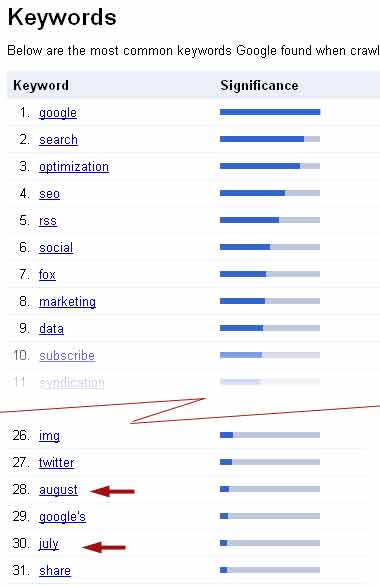
As I mentioned in my post of two weeks ago, Google Webmaster Tools displays, in order of frequency, the keywords that Google search has identified in the collection of indexed pages from a website. For this microEnterprise blog site Google considered the keywords August and July to be significant, listing them each in the top thirty results; 28th and 30th in rank respectively. These months appeared so frequently because I had set the post date format and the archive list format to show date in a verbose format. Nearly all the posts on this blog (89 of 104) so far were posted in those two summer months.
I decided I did not want the dates for posts to affect keyword significance or search results, because of their irrelevance to the content of the posts. I changed the date format displays from verbose to numeric. After nearly two weeks the offending names have dropped from 28th to 31st, and 30th to 38th. I expect that they will continue to drop further as Google proceeds to re-index the various individual post pages over time.
Showing posts with label optimization - search. Show all posts
Showing posts with label optimization - search. Show all posts
9.05.2010


9.03.2010
SEO vaporware - a note to Sandy
This is a note to 'Sandy," whoever you are. I found your comment in my spam filter. Except for Google Blogger's decision that your comment was spam, it would have gone into my "Awaiting moderation" folder. Nobody with any sense lets comments automatically post these days.
I usually don't give spam comments a second look, but I was curious to see what type of SEO optimization business would leave such a blatantly spammmy comment. I was almost sure they taught not to do that at SEO optimization school. So, the first thing I did was to check your profile, Sandy, to find out who you are. I already told you once four years ago that I insist upon knowing who I am dealing with. You do not have a public profile to look at.
Then I checked out the link you left and Googled your business name. It turns out that you have two different domain names pointing to two slightly different web sites, both of which have a Google Page Rank of ZERO. I can't help but have a few doubts about your marketing abilities. I deleted your comment.
I usually don't give spam comments a second look, but I was curious to see what type of SEO optimization business would leave such a blatantly spammmy comment. I was almost sure they taught not to do that at SEO optimization school. So, the first thing I did was to check your profile, Sandy, to find out who you are. I already told you once four years ago that I insist upon knowing who I am dealing with. You do not have a public profile to look at.
Then I checked out the link you left and Googled your business name. It turns out that you have two different domain names pointing to two slightly different web sites, both of which have a Google Page Rank of ZERO. I can't help but have a few doubts about your marketing abilities. I deleted your comment.
8.30.2010
Claiming my own marketing back yard with a hobby
Louisville, Kentucky, is not a big city, but it is big enough to have distinct sections and neighborhoods. I happen to live in Old Louisville, which is a historic preservation district containing more Victorian era residences than any other. I've lived here for a bit more than a year now. This spring into summer, before the weather became so brutally hot, I moseyed, sauntered and wandered around my new neighborhood with a digital camera taking snapshots. Photography has been a hobby of mine since high school. I took a lot of them, and I massaged them with Photoshop.
I intend to use these photographs to create a blog that will weld my name 'Tom Fox' with my local stomping grounds, 'Old Louisville.' It may take as long as a year to accomplish, but I'm not in any rush. I plan to use Seth Godin's 'drip' strategy, by daily posts of a new image with a street address. According to theory, this will burn the connection into Google's digital brain.
You can see my Old Louisville photos here. http://old-louisville.blogspot.com/
Once a day, every day, for the next 365 days, at least one new Old Louisville photograph will be posted on that blog. The key phrase is "Old Louisville," and for some reason I want to own it.
I think it will work, but there is only one way to find out for sure, and that is to do it. Since photography really is my hobby and I've already done the photo & Photoshop part just for fun, taking it this next step is fairly easy. If I had to pay someone else to do all the work, I could never afford it.
This is a form of search engine optimization, as a subset of search engine marketing. If anyone is searching for things related to 'Old Louisville," I want them to find me. I still need to devise a way to connect and interact with those who visit that blog. I suppose that would be classified as a variant of social marketing.
I intend to use these photographs to create a blog that will weld my name 'Tom Fox' with my local stomping grounds, 'Old Louisville.' It may take as long as a year to accomplish, but I'm not in any rush. I plan to use Seth Godin's 'drip' strategy, by daily posts of a new image with a street address. According to theory, this will burn the connection into Google's digital brain.
You can see my Old Louisville photos here. http://old-louisville.blogspot.com/
Once a day, every day, for the next 365 days, at least one new Old Louisville photograph will be posted on that blog. The key phrase is "Old Louisville," and for some reason I want to own it.
I think it will work, but there is only one way to find out for sure, and that is to do it. Since photography really is my hobby and I've already done the photo & Photoshop part just for fun, taking it this next step is fairly easy. If I had to pay someone else to do all the work, I could never afford it.
This is a form of search engine optimization, as a subset of search engine marketing. If anyone is searching for things related to 'Old Louisville," I want them to find me. I still need to devise a way to connect and interact with those who visit that blog. I suppose that would be classified as a variant of social marketing.
8.27.2010
SEO - Check your backlinks with Google Webmaster Tools
Checking your site's back-links with Google Webmaster Tools costs only a little bit of time and effort. Being a free service provided by Google, Webmaster Tools belongs in any bootstrapper's web toolbox. You can check the links that Google has found to your site from around the web, assuming that you installed and verified ownership of you site with Google about two months ago.
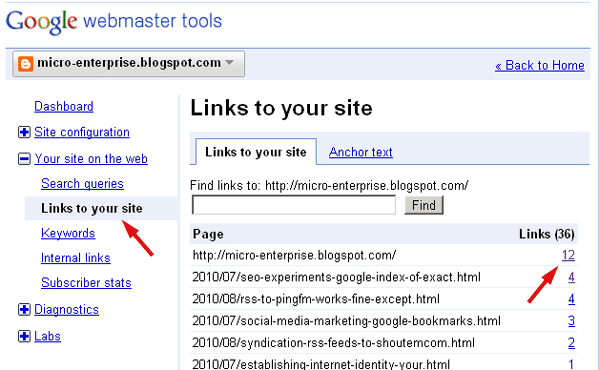
Once at the dashboard for your site in Webmaster Tools, It is three-click steps to begin learning who links to your web site. The screenshot below shows the first two clicks:
First click: Under the right sidebar menu item "Your site on the web", click "Links to your site."
Second click: Next, see the numbers in the far right column and click one.
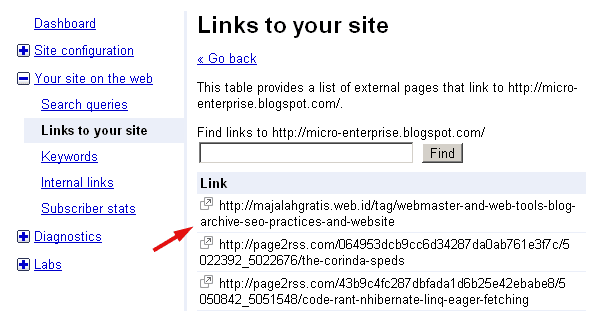
Third click: Then, on the detail page of backlinks as shown in the screenshot below, select one of the links and go see who likes you.
Once at the dashboard for your site in Webmaster Tools, It is three-click steps to begin learning who links to your web site. The screenshot below shows the first two clicks:
First click: Under the right sidebar menu item "Your site on the web", click "Links to your site."
Second click: Next, see the numbers in the far right column and click one.
Third click: Then, on the detail page of backlinks as shown in the screenshot below, select one of the links and go see who likes you.
8.25.2010
Web optimization and diminishing marginal returns
Professor Paul Samuelson stated the law of diminishing marginal returns is one of the most famous laws in all of Western economic theory. In simplest terms the law of diminishing returns means that you can throw twice as many resources at a problem, but you should not expect to necessarily get twice the results you want. This is one of the central messages of Seth Godin's book Permission Marketing.
Godin begins that book by observing in recent decades consumer oriented businesses have spent more and increasingly more money on mass-market advertising, but with decreasing effectiveness. In part this is explained by the economic principle of diminishing marginal returns. It's not the only factor in play, but it is an important one.
The idea of diminishing marginal returns is especially important for small business owners to consider when contemplating directing scarce resources toward web site optimization. Of course every small business web site owner wants more business, but the ever present questions are, how much does acquiring one more customer cost, and is it worth it?
Godin begins that book by observing in recent decades consumer oriented businesses have spent more and increasingly more money on mass-market advertising, but with decreasing effectiveness. In part this is explained by the economic principle of diminishing marginal returns. It's not the only factor in play, but it is an important one.
The idea of diminishing marginal returns is especially important for small business owners to consider when contemplating directing scarce resources toward web site optimization. Of course every small business web site owner wants more business, but the ever present questions are, how much does acquiring one more customer cost, and is it worth it?
8.24.2010
Deleting or editing blog posts
Somewhere along my searching the web I got the strong impression others think it a bad idea to ever edit or delete a blog post, regardless how crappy or irrelevant it is. Here are two quick examples. Rewriting blog history: Bad idea, and Advice: Never delete a blog post. A more balanced view is expressed by Dave Taylor in Should you ever edit or delete blog entries? There are others in a similar vein.
I take a contrarian view of the situation. Elimination is an essential part of every healthy living process, on a micro level. On a larger system level, everything is recycled and ultimately incorporated somewhere else if it has persistent value, or it is transformed.
Some think of the internet as a historical record, but that is not the way I view it.
Google maintains a site-wide keyword ranking as well as a page-specific keyword rank. I know this is true because Google Webmaster Tools reports these numbers and shows them to me in a graph. Although it is not clear to me how Google uses these site-wide keyword ranking, I know I'm not alone in my ignorance. But sometimes an extraneous series of posts may skew Google site-wide view of my web sites in a keyword direction I don't like. Eliminating the non-focused posts altogether may be the quickest solution to improve search performance, in my opinion.
But, I feel strongly about it. Especially when the abundance of my own verbosity on subject no longer of any interest to me are involved, and when they distort how search engines view the subject matter of my own blogs. I have also written about it here.
I take a contrarian view of the situation. Elimination is an essential part of every healthy living process, on a micro level. On a larger system level, everything is recycled and ultimately incorporated somewhere else if it has persistent value, or it is transformed.
Some think of the internet as a historical record, but that is not the way I view it.
Google maintains a site-wide keyword ranking as well as a page-specific keyword rank. I know this is true because Google Webmaster Tools reports these numbers and shows them to me in a graph. Although it is not clear to me how Google uses these site-wide keyword ranking, I know I'm not alone in my ignorance. But sometimes an extraneous series of posts may skew Google site-wide view of my web sites in a keyword direction I don't like. Eliminating the non-focused posts altogether may be the quickest solution to improve search performance, in my opinion.
But, I feel strongly about it. Especially when the abundance of my own verbosity on subject no longer of any interest to me are involved, and when they distort how search engines view the subject matter of my own blogs. I have also written about it here.
Webmaster Tools - Keyword view
Google Webmaster Tools shows the significant keywords of a site, as seen by the Google search index. This will depend in large part upon which pages or posts that Google has actually crawled and indexed. Rarely is it every page.
Apart from the question if Google sees as much of your site as you wish it to, there is the issue of how Google sees a site. The Google Webmaster Tools keyword data is a useful way to discover keywords you do not want to be given Google search significance. The screenshot below shows the resent keyword results for this blog after seven weeks, eighty posts, and 80 percent of the posts being indexed.
As you can see the red arrows point to "august" and "july" being counted as keywords in the top thirty of the most significant. This is not what I want, and it comes as a surprise. The month in which a post was written has little is any relevance to the content of the posts.
Now that I am aware of the problem, I can investigate it and devise a remedy.
To me it looks like the cause of this problem was my blog setting choices for date formats. I opted for a verbose display, with the names of the months spelled out for each blog post and for the blog archive display. It is a simple matter to change these settings so that dates are displayed in a purely numeric format. Actually doing that immediately changes the date format on the blog posts, but so far it seems to have had no effect upon the blog archive date format.
It makes sense to me that part of keyword optimization is to eliminate the keywords you do not want.

Apart from the question if Google sees as much of your site as you wish it to, there is the issue of how Google sees a site. The Google Webmaster Tools keyword data is a useful way to discover keywords you do not want to be given Google search significance. The screenshot below shows the resent keyword results for this blog after seven weeks, eighty posts, and 80 percent of the posts being indexed.
As you can see the red arrows point to "august" and "july" being counted as keywords in the top thirty of the most significant. This is not what I want, and it comes as a surprise. The month in which a post was written has little is any relevance to the content of the posts.
Now that I am aware of the problem, I can investigate it and devise a remedy.
To me it looks like the cause of this problem was my blog setting choices for date formats. I opted for a verbose display, with the names of the months spelled out for each blog post and for the blog archive display. It is a simple matter to change these settings so that dates are displayed in a purely numeric format. Actually doing that immediately changes the date format on the blog posts, but so far it seems to have had no effect upon the blog archive date format.
It makes sense to me that part of keyword optimization is to eliminate the keywords you do not want.
8.21.2010
And the winner is . . . Koornk
It was three weeks ago today that I began my syndication experiment with this blog, or to spam the universe through an unconscionable misuse of RSS feeds, as some might say. The main purpose of the test was to see through experience how RSS feed syndication worked in practice, using only free online services. A second purpose was to find and reach new audiences that might be interested in my writing. Third in order of discussion was the possibility of self-created back-links to this blog to increase traffic and boost PageRank.
An important issue was the question of indexing the various blogs, quasi-blogs, and micro blogs by Google. The points of interest were: (1) If, (2) When, and (3) What effect?
Today I found out the answer in a small way. My Koornk blog was the first of my testbeds to have a feed back-link indexed by Google, as shown in this screenshot. The Google search result for Koornk linked to the individual post, and not to the main blog page. Due to the quirkiness of the system I cobbled together, the back-link is not to this microenterprise blog, it is to an intermediary transmission stage of mine located on Status.net. Don't ask why. It's complicated.

An important issue was the question of indexing the various blogs, quasi-blogs, and micro blogs by Google. The points of interest were: (1) If, (2) When, and (3) What effect?
Today I found out the answer in a small way. My Koornk blog was the first of my testbeds to have a feed back-link indexed by Google, as shown in this screenshot. The Google search result for Koornk linked to the individual post, and not to the main blog page. Due to the quirkiness of the system I cobbled together, the back-link is not to this microenterprise blog, it is to an intermediary transmission stage of mine located on Status.net. Don't ask why. It's complicated.
8.16.2010
The myth of web optimization
“I think that maybe inside any business, there is someone slowly going crazy.”
— Joseph Heller
— Joseph Heller
In his business book The E Myth, author Michael Gerber states, "The technical work of a business and a business that does that technical work are two totally different things." In this sense, the ability to bake a marvelous cake and decorate it beautifully is considered 'technical' work, and it is Gerber's point that skill as a pastry chef does not necessarily translate into skill in running the business of a bakery.
Baking and managing the business of a bakery are two different skill sets.
It is very similar with search engine optimization (SEO). The ability to increase web site traffic through technical means does not necessarily result in an increase in business profitability. But it is very different from Gerber's E-Myth because most small business managers are not SEO technical experts themselves, nor do they wish to be.
Business managers are dependent upon the technical experts for SEO guidance, but in the small business world the SEO experts all too frequently have no understanding of the business needs of the entrepreneurial purpose. Optimization of a business web site is not a task that managers or business owners ought to delegate.
A business web presence is too important to trust entirely to technicians.
8.11.2010
Google site search box in Google search results page - how did they do it?
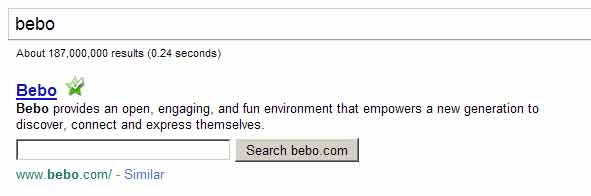
I saw this Google site search box in Google search results page (screenshot below) for the first time that I remember, ever. How did they do that?
7.30.2010
Optimization architect
More is not necessarily better. The idea of optimization does not revolve around the idea of 'more,' per se. The process of optimization is focused on the right amount of everything necessary to produce a specific result given the existing environmental constraints. And, since the process of optimization itself has a cost, it is possible to pursue optimization to excess. It is a question of balance.
In a business web environment optimization pays for itself, by definition. Otherwise, it's not optimal. Major challenges arise from accurately measuring costs and benefits for optimization efforts. Web traffic is easy to measure, so professional optimizers may be tempted to focus upon increasing web traffic, regardless of whether any business benefit results from the increase.
A local coffee shop has a website. The site's only business purpose is to promote walk-in business to the shop's physical retail storefront. If effort goes into increasing the number of visitors to the web site, but doing that does not increase the number of visitors to the coffee shop, then the effort is wasted.
It's as simple as that. Search engine optimization (SEO) is a segment of internet marketing, with the emphasis on the marketing. Search engine marketing frequently is very technical to implement. The web technicians know the tools and techniques of search optimization, but they may not be well suited to specify the purpose of optimization, design the architecture of optimization, or evaluate the results of optimization.
How, for example, would the coffee shop's web master know if the actual number of shop customers increased, or why?
Business web optimization must be designed and measured by a business intelligence. The web technicians are for implementation. The distinction is the same as between an architect and a construction contractor. The architect specifies the design, and the contractor makes it happen.
In a business web environment optimization pays for itself, by definition. Otherwise, it's not optimal. Major challenges arise from accurately measuring costs and benefits for optimization efforts. Web traffic is easy to measure, so professional optimizers may be tempted to focus upon increasing web traffic, regardless of whether any business benefit results from the increase.
A local coffee shop has a website. The site's only business purpose is to promote walk-in business to the shop's physical retail storefront. If effort goes into increasing the number of visitors to the web site, but doing that does not increase the number of visitors to the coffee shop, then the effort is wasted.
It's as simple as that. Search engine optimization (SEO) is a segment of internet marketing, with the emphasis on the marketing. Search engine marketing frequently is very technical to implement. The web technicians know the tools and techniques of search optimization, but they may not be well suited to specify the purpose of optimization, design the architecture of optimization, or evaluate the results of optimization.
How, for example, would the coffee shop's web master know if the actual number of shop customers increased, or why?
Business web optimization must be designed and measured by a business intelligence. The web technicians are for implementation. The distinction is the same as between an architect and a construction contractor. The architect specifies the design, and the contractor makes it happen.

7.27.2010
Google data inconsistency - Keywords and Insights for search
FreeTrafficSystem.com pointed out an interesting inconsistency between the search volume data provided by Google's keyword tool (part of Google Adwords) and Google's Insight for Search, for the same keywords. During the last hour or so I've vaguely sensed an explanation of the different search volume data, but I couldn't write a description that was rational and coherent. I'm stumped, except to say that Google does what it does,
I refer you to the original post linked above for all the details, plus comments.
I refer you to the original post linked above for all the details, plus comments.
7.26.2010
SEO - Optimization to an isolated peak
The successful act of optimization involves distinguishing up from down, and then moving in the direction of up. Sometimes the peak of whatever you are optimizing is obvious. Sometimes a peak is recognized by the fact that a move in any direction is a move downward. All too often, gaining the vantage point of a peak merely allows you to see higher mountains and taller peaks across the valley.
Maybe the final victory step in surmounting an optimization mountaintop and the step that springs the trap of being stuck on an isolated peak are one and the same step. When the higher ground can be achieved only by abandoning lesser goals, many dither.
See: Seth Godin - Getting unstuck: solving the perfect problem
Maybe the final victory step in surmounting an optimization mountaintop and the step that springs the trap of being stuck on an isolated peak are one and the same step. When the higher ground can be achieved only by abandoning lesser goals, many dither.
"Instability and disequilibrium are the norms; optimization won't last long. Sooner, rather than later, a product will be eclipsed at its prime. Indeed, an innovation at its prime increases its chances of being eclipsed. In Mastering the Dynamics of Innovation, a study of innovation in the automobile industry, Utterback concludes that "an unhappy byproduct of success in one generation of technology is a narrowing of focus and vulnerability to competitors championing the next technological generation." The product may be perfect, but for an increasingly smaller range of uses or customers.
"While one product is perfecting its peak, an outsider can move the entire mountain by changing the rules."
Kevin Kelly - New Rules
See: Seth Godin - Getting unstuck: solving the perfect problem
7.24.2010
SEO - img ALT text on Bing and Yahoo! search
In my post about Search engines for beginners - Submitting your site to major search engines, I indicated my success in registering ownership of this MicroEnterprise Blog with Google Webmaster Tools and Bing Toolbox, but not with Yahoo! Site Explorer.
Perhaps for that reason these MicroEnterprise blog poss are indexed on Google Search and Bing Search, but not on Yahoo! Search.
Because my post SEO - Google page rank - Understanding Google Page Rank has been indexed by both Google and Bing, it has been possible to determine that the <img alt="TEXT"> part of the images in that post were indexed by Google, but not indexed by Bing. So far with Yahoo! Search the answer remains unknown. In this, Yahoo! and Bing return different results. Yahoo! does not return anything at all.
Related posts:
SEO experiments - Google index of exact quotes
Site Optimization - using img alt tags
Site optimization - additional test of img alt tag text
Perhaps for that reason these MicroEnterprise blog poss are indexed on Google Search and Bing Search, but not on Yahoo! Search.
Because my post SEO - Google page rank - Understanding Google Page Rank has been indexed by both Google and Bing, it has been possible to determine that the <img alt="TEXT"> part of the images in that post were indexed by Google, but not indexed by Bing. So far with Yahoo! Search the answer remains unknown. In this, Yahoo! and Bing return different results. Yahoo! does not return anything at all.
Related posts:
7.23.2010
SEO - Google's keyword tool
I have to assume that nobody knows search engine optimization better than Google. Google has its standard of excellence for web pages hinged to Google's purpose of giving people what they are looking for. It's a simple matter that when Google says web masters ought to do this, that, and another thing, then the smart thing to do is this, that, and whatever else Google says.
It is especially easy since Google has gone to such great detail to explain what they look for, and it has made the information easily available. Plus, Google has also provided an assortment of well designed, useful, and free tools with which to work. By steadily adding to its collection of web master tools over the years, Google has not only provided a valuable web toolbox, it has also put a number of SEO enterprises out of business. What was previously available only for a price is now available for free, and the information is more authoritatively reliable.
One such example is the Keyword Tool contained within Google's Adwords program. By using this tool for the keyword "SEO," the suggestions shown in the screenshot below were quickly provided. The list shown is a small part of the whole, and it is sorted by "local monthly searches." In this instance, "local" means the United States.
Screenshot 1 - 20100723-01

It is especially easy since Google has gone to such great detail to explain what they look for, and it has made the information easily available. Plus, Google has also provided an assortment of well designed, useful, and free tools with which to work. By steadily adding to its collection of web master tools over the years, Google has not only provided a valuable web toolbox, it has also put a number of SEO enterprises out of business. What was previously available only for a price is now available for free, and the information is more authoritatively reliable.
One such example is the Keyword Tool contained within Google's Adwords program. By using this tool for the keyword "SEO," the suggestions shown in the screenshot below were quickly provided. The list shown is a small part of the whole, and it is sorted by "local monthly searches." In this instance, "local" means the United States.
Screenshot 1 - 20100723-01
7.22.2010
SEO - The cost of optimization
In 2006, Ralph Wilson stated on Wilsonweb.com that a typical web optimization service first stage implementation could cost $1500 to $2000, with a continuing monthly cost of several hundred dollars.
Dr. Wilson does not mention any way to gauge whether the cost of optimization is worth it or not. Whether it is worth it is a prime consideration of the Bootstrapper's manifesto, in part: "I will measure what I do."
Dr. Wilson does not mention any way to gauge whether the cost of optimization is worth it or not. Whether it is worth it is a prime consideration of the Bootstrapper's manifesto, in part: "I will measure what I do."
7.21.2010
SEO - Google page rank
Understanding Google Page Rank
Google Page Rank is an extremely important part of how Google views the relative significance of various competing web pages. For Google, 'relevance' and 'importance' are nearly the same, and are closely linked. PageRank® Technology is crucial to understanding how Google operates and how web pages are prioritized by it. It is a complicated, patented, and trademarked process of Google that is partially known to the public through the details of the patent application, but partly unknown.
Google's patented PageRank® Technology is reflected in the Page Rank number Google assigns to each indexed page. This number does not show by any ordinary means, but it is knowable.
Determining Google Page Rank
Knowing the specific Page Rank of an individual page is much easier, with the use of the Google Toolbar that is available for Internet Explorer and Firefox browsers.
Screenshot 1 - 20100721-01

With the Google Toolbar installed on MS Internet Explorer 8, the green bar graph shown above indicated the general Page Rank of the current page online. When the cursor is hovered-over the graph, a text box pops up indicating the specific numeric Page Rank. In this case the Page Rank is 7 out of 10.
Screenshot 2 - 20100721-02

With a left click of the mouse, a pop-up menu shows the following options:
The Google Toolbar is the quickest and easiest method I know to check a page's Page Rank.
If the Google Toolbar is not your cup of tea, you can also check the page rank of a page by pasting its url in the text box below.
Google page rank - zero is better than nothing
When the Google Toolbar page rank graph is empty grey, it means that Google has not yet assigned a page rank to the current page, as shown here.
Screenshot 3 - 20100721-03

When the Google Toolbar page rank graph is empty white, it means that Google views the importance of the current page as zero. It is better than nothing since it means Google knows the existence of the page.
Screenshot 4 - 20100721-04

Google Page Rank is an extremely important part of how Google views the relative significance of various competing web pages. For Google, 'relevance' and 'importance' are nearly the same, and are closely linked. PageRank® Technology is crucial to understanding how Google operates and how web pages are prioritized by it. It is a complicated, patented, and trademarked process of Google that is partially known to the public through the details of the patent application, but partly unknown.
Google's patented PageRank® Technology is reflected in the Page Rank number Google assigns to each indexed page. This number does not show by any ordinary means, but it is knowable.
"PageRank reflects our view of the importance of web pages by considering more than 500 million variables and 2 billion terms. Pages that we believe are important pages receive a higher PageRank and are more likely to appear at the top of the search results."
Google corporate 2010-07-21WebWorkshop - Google's Page Rank explained
Determining Google Page Rank
Knowing the specific Page Rank of an individual page is much easier, with the use of the Google Toolbar that is available for Internet Explorer and Firefox browsers.
Screenshot 1 - 20100721-01
With the Google Toolbar installed on MS Internet Explorer 8, the green bar graph shown above indicated the general Page Rank of the current page online. When the cursor is hovered-over the graph, a text box pops up indicating the specific numeric Page Rank. In this case the Page Rank is 7 out of 10.
Screenshot 2 - 20100721-02
With a left click of the mouse, a pop-up menu shows the following options:
- Cached snapshot of page
- Similar pages
- Backwards links
The Google Toolbar is the quickest and easiest method I know to check a page's Page Rank.
If the Google Toolbar is not your cup of tea, you can also check the page rank of a page by pasting its url in the text box below.
Check Page Rank of your Web site pages instantly: |
This page rank checking tool is powered by Page Rank Checker service |
When the Google Toolbar page rank graph is empty grey, it means that Google has not yet assigned a page rank to the current page, as shown here.
Screenshot 3 - 20100721-03
When the Google Toolbar page rank graph is empty white, it means that Google views the importance of the current page as zero. It is better than nothing since it means Google knows the existence of the page.
Screenshot 4 - 20100721-04
7.20.2010
Search optimization - structured data
Search optimization
structured data
Structured data is a phrase that covers the general idea of using HTML tag capabilities to mark certain common data types with standardized methods. In recent years, Google has adopted the use of three different structured data type standards for embedding seven common data items:
Example — Business listing using microdata format
The above listed code will display as follows:
structured data
Structured data is a phrase that covers the general idea of using HTML tag capabilities to mark certain common data types with standardized methods. In recent years, Google has adopted the use of three different structured data type standards for embedding seven common data items:
- Recipes
- Reviews
- Review ratings
- People
- Events
- Businesses and organizations
- Products
Example — Business listing using microdata format
<div itemscope itemtype="http://data-vocabulary.org/Organization">
   <span itemprop="name">Carmen-Thomas Designs</span> <br />
   <span itemprop="address" itemscope itemtype="http://data-vocabulary.org/Address">
   <span itemprop="street-address">1218 S. Second Street</span> <br />
      <span itemprop="locality">Louisville</span>
      <span itemprop="region">Kentucky</span> <br />
    </span>
    Phone: <span itemprop="tel">502-230-1613</span>.
    <a href="http://carmen-thomas-designs.blogspot.com/" itemprop="url">http://carmen-thomas-designs.blogspot.com/</a>.
</div>
The above listed code will display as follows:
Carmen-Thomas Designs
1218 S. Second Street
Louisville, Kentucky
Phone: 502-230-16134.
http://carmen-thomas-designs.blogspot.com/.
1218 S. Second Street
Louisville, Kentucky
Phone: 502-230-16134.
http://carmen-thomas-designs.blogspot.com/.
7.19.2010
MarketingExperiments Research Journal
Recommended reading
Marketing Experiments Research Journal, vol 1, no 2, Second Quarter 2010
This issue is a downloadable PDF file with 132 pages of articles in four broad categories:
Also: The Marketing Experiments Research Journal, vol 1, no 1, First Quarter 2010
Marketing Experiments Research Journal, vol 1, no 2, Second Quarter 2010
"Many people will likely bounce from [a page] when they don’t immediately find what drove them there in the first place."
— Marketing Experiments Research JournalMarketingExperiments.com is a research group with a simple mission statement: To discover what really works in optimization. They focus all of their experiments on optimizing marketing communications. They test every conceivable approach and we publish the results in the MarketingExperiments Journal.
This issue is a downloadable PDF file with 132 pages of articles in four broad categories:
- Marketing optimization - 11 articles
- Integrate Your Marketing: How one company combined offline and online marketing to increase subscriptions by 124%
- Ask the Scientist: MarketingExperiments Optimization Sequence
- Evidence-based Marketing: Why you need more than just numbers to truly drive ROI
- Tricks vs. Testing: The Battle for Internet Supremacy
- Flash Banner vs. Headline, Lead Quantity vs. Lead Quality: The fight for online marketing ROI continues
- Online Marketing Tricks vs. Testing: The Thrilla on Mozilla
- 100 Tips for Trade Show Lead Generation
- Ask the Scientist: Price testing methods and practices
- Multivariate Testing: Can you radically improve marketing ROI by increasing variables you test?
- Cost of Delay: How to win approval for your test and test schedule
- The Business Case for Testing: How one marketer convinced her business leaders to start testing and drove a 201% gain in the process
- Social media marketing - 6 articles
- Facebook Case Study: From 517 to 33,000 fans in two weeks (plus media coverage)
- Social Media Case Study: Facebook plus integrated marketing helps raise $950,000
- Connecting Social Networks Pays Off
- Holistic Marketing Optimization: What’s more likely to show up on Twitter?
- Social Media Marketing Human Factor: Finding the right person for the job
- Social Media for the COO: How to become the Michael Phelps of implementing social media in your organization
- Search optimization - 2 articles
- Search Marketing: Tips on mastering the latest innovations in this mature category
- Google Caffeine: Use social media and quality content to get a jolt for your site
- Site optimization - 8 articles
- 1:1 Marketing at Four Levels: Strategic ways every marketer can enter into an online conversation with customers
- One-to-One Marketing: The true promise of Dynamic Offer-Content Customization
- Web Team Roles, Web Designer: Are you trying to buy bread from the butcher?
- Web Team Roles, Web Developer: What exactly does a developer “develop,” anyway?
- What Else Can I Test… On My E-commerce Or Lead Generation Website?
- Marketing Optimization Technology: Be careful of shooting yourself (and your test) in the foot
- Google Analytics: New browser-based, data-privacy opt out important, but what consumers really need is education
- Technology Blind Spots: How human insight revealed a hidden (and almost missed) 31% gain
"It is crucial to understand the connection between offline and online marketing. To get maximum ROI from your marketing spend, you must integrate all of your activities and make the connection between your traditional marketing and web conversions.Authors and contributors
— Marketing Experiments Research Journal
- Daniel Burstein
- Brian Carroll, CEO of InTouch
- Adam Davis, Director of Technology
- Jimmy Ellis
- Dr. Flint McGlaughlin, Director of MECLABS Group
- Boris Grinkot, Senior Manager, Research and Strategy
- Scott Howard, Director of Operations
- Bob Kemper, Director of Sciences, MECLABS Group
- Pamela Markey
- Austin McCraw
- Andy Mott
- Jon Powell, Research Analyst
- Arturo Silva
- Adam T. Sutton, Reporter at MarketingSherpa
- Nathan Thompson, Research Analyst
- Gina Townsend
- Corey Trent, Research Analyst
Also: The Marketing Experiments Research Journal, vol 1, no 1, First Quarter 2010
7.17.2010
Search optimization - the semantic web
Humans are capable of using the Web to carry out tasks such as finding the closest pizza place open after midnight, selecting and ordering a book on Amazon, and searching for a low price for a digital camera. However, a computer cannot accomplish all of these tasks without human direction, because web pages are designed to be read by people, not machines. The semantic web is a vision of information that is understandable by computers. The goal is for computers to perform more of the tedious work involved in finding, combining, and acting upon information on the web.
In 1999 Tim Berners-Lee first stated a vision of the semantic web like this:
In 1999 Tim Berners-Lee first stated a vision of the semantic web like this:
I have a dream for the Web [in which computers] become capable of analyzing all the data on the Web – the content, links, and transactions between people and computers. A ‘Semantic Web’, which should make this possible, has yet to emerge, but when it does, the day-to-day mechanisms of trade, bureaucracy and our daily lives will be handled by machines talking to machines. The ‘intelligent agents’ people have touted for ages will finally materialize.The Semantic Web is a vision for the future of the Web in which information is given explicit meaning, making it easier for machines to automatically process and integrate information available on the Web. Web Ontology Language
Subscribe to:
Posts (Atom)


 Posts
Posts

