As I mentioned in my post of two weeks ago, Google Webmaster Tools displays, in order of frequency, the keywords that Google search has identified in the collection of indexed pages from a website. For this microEnterprise blog site Google considered the keywords August and July to be significant, listing them each in the top thirty results; 28th and 30th in rank respectively. These months appeared so frequently because I had set the post date format and the archive list format to show date in a verbose format. Nearly all the posts on this blog (89 of 104) so far were posted in those two summer months.
I decided I did not want the dates for posts to affect keyword significance or search results, because of their irrelevance to the content of the posts. I changed the date format displays from verbose to numeric. After nearly two weeks the offending names have dropped from 28th to 31st, and 30th to 38th. I expect that they will continue to drop further as Google proceeds to re-index the various individual post pages over time.
Showing posts with label marketing - keywords. Show all posts
Showing posts with label marketing - keywords. Show all posts
9.05.2010


8.30.2010
Claiming my own marketing back yard with a hobby
Louisville, Kentucky, is not a big city, but it is big enough to have distinct sections and neighborhoods. I happen to live in Old Louisville, which is a historic preservation district containing more Victorian era residences than any other. I've lived here for a bit more than a year now. This spring into summer, before the weather became so brutally hot, I moseyed, sauntered and wandered around my new neighborhood with a digital camera taking snapshots. Photography has been a hobby of mine since high school. I took a lot of them, and I massaged them with Photoshop.
I intend to use these photographs to create a blog that will weld my name 'Tom Fox' with my local stomping grounds, 'Old Louisville.' It may take as long as a year to accomplish, but I'm not in any rush. I plan to use Seth Godin's 'drip' strategy, by daily posts of a new image with a street address. According to theory, this will burn the connection into Google's digital brain.
You can see my Old Louisville photos here. http://old-louisville.blogspot.com/
Once a day, every day, for the next 365 days, at least one new Old Louisville photograph will be posted on that blog. The key phrase is "Old Louisville," and for some reason I want to own it.
I think it will work, but there is only one way to find out for sure, and that is to do it. Since photography really is my hobby and I've already done the photo & Photoshop part just for fun, taking it this next step is fairly easy. If I had to pay someone else to do all the work, I could never afford it.
This is a form of search engine optimization, as a subset of search engine marketing. If anyone is searching for things related to 'Old Louisville," I want them to find me. I still need to devise a way to connect and interact with those who visit that blog. I suppose that would be classified as a variant of social marketing.
I intend to use these photographs to create a blog that will weld my name 'Tom Fox' with my local stomping grounds, 'Old Louisville.' It may take as long as a year to accomplish, but I'm not in any rush. I plan to use Seth Godin's 'drip' strategy, by daily posts of a new image with a street address. According to theory, this will burn the connection into Google's digital brain.
You can see my Old Louisville photos here. http://old-louisville.blogspot.com/
Once a day, every day, for the next 365 days, at least one new Old Louisville photograph will be posted on that blog. The key phrase is "Old Louisville," and for some reason I want to own it.
I think it will work, but there is only one way to find out for sure, and that is to do it. Since photography really is my hobby and I've already done the photo & Photoshop part just for fun, taking it this next step is fairly easy. If I had to pay someone else to do all the work, I could never afford it.
This is a form of search engine optimization, as a subset of search engine marketing. If anyone is searching for things related to 'Old Louisville," I want them to find me. I still need to devise a way to connect and interact with those who visit that blog. I suppose that would be classified as a variant of social marketing.
8.24.2010
Deleting or editing blog posts
Somewhere along my searching the web I got the strong impression others think it a bad idea to ever edit or delete a blog post, regardless how crappy or irrelevant it is. Here are two quick examples. Rewriting blog history: Bad idea, and Advice: Never delete a blog post. A more balanced view is expressed by Dave Taylor in Should you ever edit or delete blog entries? There are others in a similar vein.
I take a contrarian view of the situation. Elimination is an essential part of every healthy living process, on a micro level. On a larger system level, everything is recycled and ultimately incorporated somewhere else if it has persistent value, or it is transformed.
Some think of the internet as a historical record, but that is not the way I view it.
Google maintains a site-wide keyword ranking as well as a page-specific keyword rank. I know this is true because Google Webmaster Tools reports these numbers and shows them to me in a graph. Although it is not clear to me how Google uses these site-wide keyword ranking, I know I'm not alone in my ignorance. But sometimes an extraneous series of posts may skew Google site-wide view of my web sites in a keyword direction I don't like. Eliminating the non-focused posts altogether may be the quickest solution to improve search performance, in my opinion.
But, I feel strongly about it. Especially when the abundance of my own verbosity on subject no longer of any interest to me are involved, and when they distort how search engines view the subject matter of my own blogs. I have also written about it here.
I take a contrarian view of the situation. Elimination is an essential part of every healthy living process, on a micro level. On a larger system level, everything is recycled and ultimately incorporated somewhere else if it has persistent value, or it is transformed.
Some think of the internet as a historical record, but that is not the way I view it.
Google maintains a site-wide keyword ranking as well as a page-specific keyword rank. I know this is true because Google Webmaster Tools reports these numbers and shows them to me in a graph. Although it is not clear to me how Google uses these site-wide keyword ranking, I know I'm not alone in my ignorance. But sometimes an extraneous series of posts may skew Google site-wide view of my web sites in a keyword direction I don't like. Eliminating the non-focused posts altogether may be the quickest solution to improve search performance, in my opinion.
But, I feel strongly about it. Especially when the abundance of my own verbosity on subject no longer of any interest to me are involved, and when they distort how search engines view the subject matter of my own blogs. I have also written about it here.
Webmaster Tools - Keyword view
Google Webmaster Tools shows the significant keywords of a site, as seen by the Google search index. This will depend in large part upon which pages or posts that Google has actually crawled and indexed. Rarely is it every page.
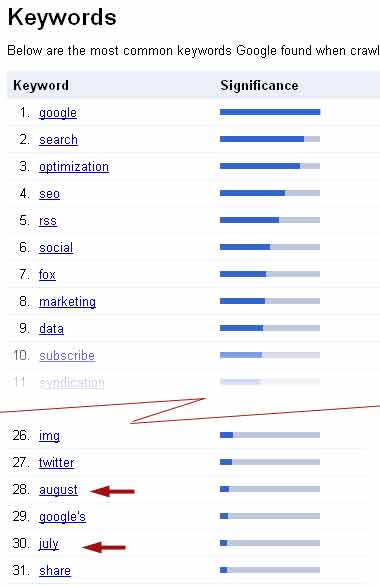
Apart from the question if Google sees as much of your site as you wish it to, there is the issue of how Google sees a site. The Google Webmaster Tools keyword data is a useful way to discover keywords you do not want to be given Google search significance. The screenshot below shows the resent keyword results for this blog after seven weeks, eighty posts, and 80 percent of the posts being indexed.
As you can see the red arrows point to "august" and "july" being counted as keywords in the top thirty of the most significant. This is not what I want, and it comes as a surprise. The month in which a post was written has little is any relevance to the content of the posts.
Now that I am aware of the problem, I can investigate it and devise a remedy.
To me it looks like the cause of this problem was my blog setting choices for date formats. I opted for a verbose display, with the names of the months spelled out for each blog post and for the blog archive display. It is a simple matter to change these settings so that dates are displayed in a purely numeric format. Actually doing that immediately changes the date format on the blog posts, but so far it seems to have had no effect upon the blog archive date format.
It makes sense to me that part of keyword optimization is to eliminate the keywords you do not want.

Apart from the question if Google sees as much of your site as you wish it to, there is the issue of how Google sees a site. The Google Webmaster Tools keyword data is a useful way to discover keywords you do not want to be given Google search significance. The screenshot below shows the resent keyword results for this blog after seven weeks, eighty posts, and 80 percent of the posts being indexed.
As you can see the red arrows point to "august" and "july" being counted as keywords in the top thirty of the most significant. This is not what I want, and it comes as a surprise. The month in which a post was written has little is any relevance to the content of the posts.
Now that I am aware of the problem, I can investigate it and devise a remedy.
To me it looks like the cause of this problem was my blog setting choices for date formats. I opted for a verbose display, with the names of the months spelled out for each blog post and for the blog archive display. It is a simple matter to change these settings so that dates are displayed in a purely numeric format. Actually doing that immediately changes the date format on the blog posts, but so far it seems to have had no effect upon the blog archive date format.
It makes sense to me that part of keyword optimization is to eliminate the keywords you do not want.
7.23.2010
SEO - Google's keyword tool
I have to assume that nobody knows search engine optimization better than Google. Google has its standard of excellence for web pages hinged to Google's purpose of giving people what they are looking for. It's a simple matter that when Google says web masters ought to do this, that, and another thing, then the smart thing to do is this, that, and whatever else Google says.
It is especially easy since Google has gone to such great detail to explain what they look for, and it has made the information easily available. Plus, Google has also provided an assortment of well designed, useful, and free tools with which to work. By steadily adding to its collection of web master tools over the years, Google has not only provided a valuable web toolbox, it has also put a number of SEO enterprises out of business. What was previously available only for a price is now available for free, and the information is more authoritatively reliable.
One such example is the Keyword Tool contained within Google's Adwords program. By using this tool for the keyword "SEO," the suggestions shown in the screenshot below were quickly provided. The list shown is a small part of the whole, and it is sorted by "local monthly searches." In this instance, "local" means the United States.
Screenshot 1 - 20100723-01

It is especially easy since Google has gone to such great detail to explain what they look for, and it has made the information easily available. Plus, Google has also provided an assortment of well designed, useful, and free tools with which to work. By steadily adding to its collection of web master tools over the years, Google has not only provided a valuable web toolbox, it has also put a number of SEO enterprises out of business. What was previously available only for a price is now available for free, and the information is more authoritatively reliable.
One such example is the Keyword Tool contained within Google's Adwords program. By using this tool for the keyword "SEO," the suggestions shown in the screenshot below were quickly provided. The list shown is a small part of the whole, and it is sorted by "local monthly searches." In this instance, "local" means the United States.
Screenshot 1 - 20100723-01

Subscribe to:
Posts (Atom)


 Posts
Posts

