Somewhere along my searching the web I got the strong impression others think it a bad idea to ever edit or delete a blog post, regardless how crappy or irrelevant it is. Here are two quick examples. Rewriting blog history: Bad idea, and Advice: Never delete a blog post. A more balanced view is expressed by Dave Taylor in Should you ever edit or delete blog entries? There are others in a similar vein.
I take a contrarian view of the situation. Elimination is an essential part of every healthy living process, on a micro level. On a larger system level, everything is recycled and ultimately incorporated somewhere else if it has persistent value, or it is transformed.
Some think of the internet as a historical record, but that is not the way I view it.
Google maintains a site-wide keyword ranking as well as a page-specific keyword rank. I know this is true because Google Webmaster Tools reports these numbers and shows them to me in a graph. Although it is not clear to me how Google uses these site-wide keyword ranking, I know I'm not alone in my ignorance. But sometimes an extraneous series of posts may skew Google site-wide view of my web sites in a keyword direction I don't like. Eliminating the non-focused posts altogether may be the quickest solution to improve search performance, in my opinion.
But, I feel strongly about it. Especially when the abundance of my own verbosity on subject no longer of any interest to me are involved, and when they distort how search engines view the subject matter of my own blogs. I have also written about it here.
Showing posts with label Google search. Show all posts
Showing posts with label Google search. Show all posts
8.24.2010


8.18.2010
Google Caffeine is really fast
Google announced its new web indexing system called Caffeine in the first part of June this year.

Voilá! There it was! Fast!

"Our old index had several layers, some of which were refreshed at a faster rate than others; the main layer would update every couple of weeks. To refresh a layer of the old index, we would analyze the entire web, which meant there was a significant delay between when we found a page and made it available to you."My test of Google's improved speed claim was to perform a Google search on the title of my last blog post, Motoral uses Open Source StatusNet, within less than 120 seconds after posting it.
The Official Google Blog
Voilá! There it was! Fast!
8.16.2010
Does Google index PDF files?
Question: Does Google index PDF files?
Answer: Yup, as long a the PDF is not encrypted or password protected, and it meets Google's other standards of index-ability, whatever they are. PDF files are frequently returned by a Google search. Google has indexed PDF files since at least 2001, going by Search Engine Watch According to GOS Blog in 2006, Google also uses Optical Character Recognition (OCR) to index PDF files consisting of scanned pages. This was confirmed in 2008 on the official Google Blog.
Furthermore, PDF files can contain hyper-links, if you put them there. You know, links to URLs. Frequently the significance of this may be overlooked for SEO and marketing purposes.
A list of file types that Google indexes: Google Webmaster Central
Answer: Yup, as long a the PDF is not encrypted or password protected, and it meets Google's other standards of index-ability, whatever they are. PDF files are frequently returned by a Google search. Google has indexed PDF files since at least 2001, going by Search Engine Watch According to GOS Blog in 2006, Google also uses Optical Character Recognition (OCR) to index PDF files consisting of scanned pages. This was confirmed in 2008 on the official Google Blog.
Furthermore, PDF files can contain hyper-links, if you put them there. You know, links to URLs. Frequently the significance of this may be overlooked for SEO and marketing purposes.
A list of file types that Google indexes: Google Webmaster Central
"PDF formatted files are the most popular after HTML files. PostScript and Microsoft Word files are also fairly common. The other file types are relatively uncommon by comparison."Google FAQ - Filetypes
8.15.2010
Google search quiz answer - sitelinks
The answer to my July 30 Google search quiz - How did they do that?
How they did it is still a mystery internal to the secret workings of the Google search machine, but there is a name for it — Sitelinks. A webmaster can facilitate the creation of useful Sitelinks in Google's search results for a site by creating a nice logical and clearly defined hierarchical site structure and navigation system. Doing this is just what Google recommends webmasters do. But the time and the manner of Google Sitelinks, if they happen at all, is up to Google. That's the way it is, as stated by Google in the screenshot below showing Google Webmaster Tools Sitelinks page.

How they did it is still a mystery internal to the secret workings of the Google search machine, but there is a name for it — Sitelinks. A webmaster can facilitate the creation of useful Sitelinks in Google's search results for a site by creating a nice logical and clearly defined hierarchical site structure and navigation system. Doing this is just what Google recommends webmasters do. But the time and the manner of Google Sitelinks, if they happen at all, is up to Google. That's the way it is, as stated by Google in the screenshot below showing Google Webmaster Tools Sitelinks page.
"Sitelinks are links to a site's interior pages. Not all sites have sitelinks. Google generates these links automatically, but you can remove sitelinks you [the webmaster] don't want."
8.11.2010
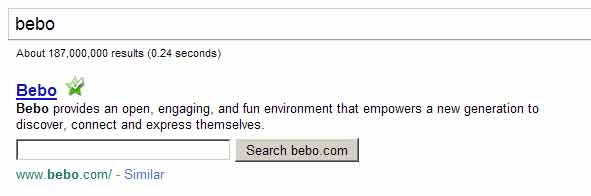
Google site search box in Google search results page - how did they do it?
I saw this Google site search box in Google search results page (screenshot below) for the first time that I remember, ever. How did they do that?
7.30.2010
Google search quiz - How did they do that?
A Google search on the term "cluetrain" yields results shown in the screenshot below. The interesting part of Google results are the many Cluetrain site sub-divisions: The book, Table of contents, etc.
But, take a look at the www.cluetrain.com web site. What did Cluetrain.com do, or what did Google do, to produce the detailed search result listing?

August 15th — Answer found here — Google search quiz answer - sitelinks
But, take a look at the www.cluetrain.com web site. What did Cluetrain.com do, or what did Google do, to produce the detailed search result listing?
August 15th — Answer found here — Google search quiz answer - sitelinks
7.29.2010
The future of search is the future
Wired magazine reports that Google and the CIA have both recently invested in the web technology company Recorded Future. "The world's first Temporal Analytics Engine . . . that allows you to visualize the future, past or present."
Recorded Future examines public web pages, blogs, and social networking sites and extracts the people, places and the activities they mention.
For Google, any significant progress toward perfecting this collection of analytical techniques could go a long way toward accurately classifying the large amounts of unstructured data on the web, and produce more relevant and timely search results.
Unlike many ventures invested in by the C.I.A., Recorded Future is not a big secret totally hidden from view. Recorded Future is live on the web, offering its analytical services for a monthly fee, or a striped down version for free. The free version (my choice) offers daily or weekly alerts to the following topics:
Recorded Future examines public web pages, blogs, and social networking sites and extracts the people, places and the activities they mention.
- Who is involved - identity analysis..
- The type of event - activity analysis.
- Location of the event - spatial analysis.
- The time of the event, past or future - temporal analysis.
- Attitude toward the event - sentiment analysis.
For Google, any significant progress toward perfecting this collection of analytical techniques could go a long way toward accurately classifying the large amounts of unstructured data on the web, and produce more relevant and timely search results.
Unlike many ventures invested in by the C.I.A., Recorded Future is not a big secret totally hidden from view. Recorded Future is live on the web, offering its analytical services for a monthly fee, or a striped down version for free. The free version (my choice) offers daily or weekly alerts to the following topics:
- Financial markets
- Geopolitical
- Industry analysis
- Public figures
- Technology sector
- Myself or my company

7.25.2010
SEO experiments - Google index of Google Bookmark comments
So far there is no indication that Google indexes and serves the comments attached to Google Bookmarks links. This doesn't mean that Google ignores those links or comments entirely, but how they are used by Google remains unknown to me. It is a matter for speculative inquiry, patience, and more SEO experiments..
SEO experiments - Google index of exact quotes
In these three preceding posts I demonstrated to my own satisfaction at least that Google indexes the ALT text contained within HTML IMG tags, but that Microsoft Bing does not. Yahoo! search results are unavailable for the simple reason that Yahoo! has not indexed any of the posts on this blog more recent than a year ago.
I used two unique phrase descriptions in the ALT text portion of the IMG tag for two different screenshots contained within two different posts. I then included these exact text phrases in subsequent postings to this blog.
I will not repeat those two text phrases here in this post for fear of screwing things up even more.
Today when I do a Google search on those two phrases I still find confirmation that Google does indeed index ALT text, it also uses ALT text to return on an exact quote search.
The first search item returned in the second test example resulted from an index hit on the ALT text contained with an IMG tag.
The second SEO test example also shows how an RSS feed of this blog on another site can produce odd and unpredictable results with Google. Why Google does what it does the way it does it is a continuing puzzle. The only thing I'm sure of is when I repeat these two search experiments again tomorrow, the results will be different from today..
SEO experiment - Example 1

SEO experiment - Example 2

- Site Optimization - using img alt tags
- Site optimization - additional test of img alt tag text
- SEO - img ALT text on Bing and Yahoo! search
I used two unique phrase descriptions in the ALT text portion of the IMG tag for two different screenshots contained within two different posts. I then included these exact text phrases in subsequent postings to this blog.
I will not repeat those two text phrases here in this post for fear of screwing things up even more.
Today when I do a Google search on those two phrases I still find confirmation that Google does indeed index ALT text, it also uses ALT text to return on an exact quote search.
The first search item returned in the second test example resulted from an index hit on the ALT text contained with an IMG tag.
The second SEO test example also shows how an RSS feed of this blog on another site can produce odd and unpredictable results with Google. Why Google does what it does the way it does it is a continuing puzzle. The only thing I'm sure of is when I repeat these two search experiments again tomorrow, the results will be different from today..
SEO experiment - Example 1
SEO experiment - Example 2
Subscribe to:
Posts (Atom)


 Posts
Posts

